INNOVATION
China's Floating Turbine Rewrites the Record Books
China Three Gorges installs the world's largest floating offshore wind turbine off Guangdong, proving deep-water wind is no longer theoretical
3 Jun 2026
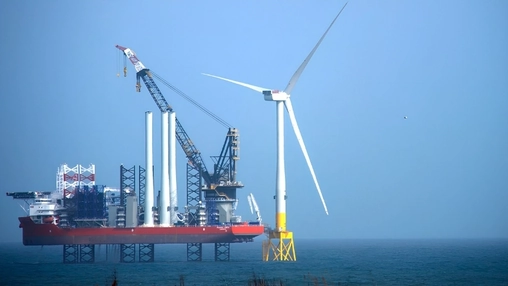
China Three Gorges Corporation installed the world's largest single-unit floating offshore wind turbine on 2 May 2026, positioning the state-owned energy group at the front of a global race to prove deep-water wind at scale. The 16 MW Three Gorges Pilot platform sits in more than 50 metres of water, roughly 70 kilometres off the coast of Guangdong Province.
The semi-submersible hull stretches 91 metres across, displaces 24,100 tonnes, and carries a rotor 252 metres in diameter. Projected annual output stands at 44.65 GWh, sufficient according to the developer to supply around 24,000 households.
Four systems appear here for the first time in China's offshore sector. An active ballast arrangement redistributes water across three column tanks to stabilise the hull under wind and wave loading. Nine suction anchors hold the platform via anchor chains and polyester mooring lines, each rated to 1,300 tonnes of tensile load and designed to absorb wave energy through stretch rather than rigid resistance. Shore connection runs through a domestically developed 66 kV submarine cable engineered for continuous cyclic stress in harsh conditions.
Cost per kilowatt has fallen more than 50 per cent against China Three Gorges' earlier floating unit from 2021, while output nearly triples over the same comparison period.
Rated for supertyphoon conditions with wave heights above 20 metres and wind speeds of up to 73 metres per second, the platform offers a structural data point the floating wind sector has lacked. European developers approaching their first commercial-scale floating projects are targeting turbines in the 15 to 18 MW range; verified performance from a single-unit system operating under conditions more severe than a typical North Sea environment adds weight to the engineering and financing case for those schemes. Analysts caution that China's subsidised fabrication base and domestic content requirements complicate direct cost comparisons with European supply chains.
Whether the data translates across regulatory and commercial contexts remains an open question.
Related News


SUBSCRIBE FOR UPDATES
By submitting, you agree to receive email communications from the event organizers, including upcoming promotions and discounted tickets, news, and access to related events.